The Future of AI Is Resource-Efficient and We’re Building It
Blog Summary – TL;DR
AI is getting more powerful, but also more expensive, harder to run, and increasingly out of reach for much of the world. Rising compute costs, energy demands, and infrastructure constraints are creating a future where only a few can afford to build and deploy AI at scale.
At Lelapa AI, we are building a different path. We design language AI for efficiency from the ground up so it can work in real-world conditions, across languages, regions, and levels of infrastructure. From Vulavula and InkubaLM to the Esethu Framework, ViXSD, and years of applied research, our work shows how resource-efficient AI makes it possible for AI to reach more people, more communities, and more economies.
If AI is going to serve everyone and not just those with unlimited compute, this is how it gets built.
What Lelapa AI’s efficiency-first approach means for the future of language AI
As artificial intelligence becomes more deeply embedded in everyday systems, one challenge has become impossible to ignore: cost. The global AI ecosystem is grappling with rising compute demands, soaring energy requirements, and infrastructure constraints that make large-scale deployment increasingly difficult.
Late last year, these challenges featured prominently in global policy discussions, including those held around the G20. While those conversations have since moved on, the underlying questions remain urgent. How do we build AI systems that are affordable, sustainable, and capable of serving diverse societies at scale?
At Lelapa AI, this question has shaped our work from the beginning.
The global problem behind rising AI costs
Today’s dominant AI architectures rely on vast datasets, heavy compute, and expensive infrastructure. As models grow larger, serving costs rise sharply. In many cases, large technology companies absorb the majority of these costs themselves, a model that is neither sustainable nor globally replicable.
This reality widens existing divides. Countries with limited digital infrastructure struggle to adopt advanced AI systems, while even high-resource markets face mounting pressure to justify long-term energy use and operational expense. The challenge is no longer access alone. It is economic viability.
Policy conversations, including those previously held at the G20, have highlighted interconnected issues such as data governance, digital inclusion, MSME participation, and the need for trustworthy AI systems. Addressing these issues requires more than regulation. It requires a different way of building AI.
Designing for constraint, not abundance
Lelapa AI builds language technologies designed to operate in complex, multilingual, and data-scarce environments. Rather than adapting large systems after the fact, we design for efficiency from the start.
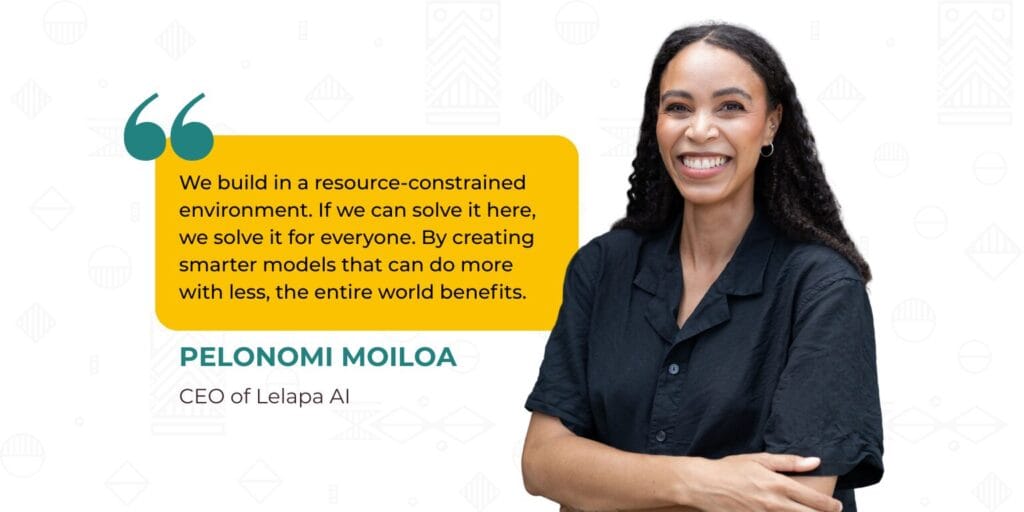
“We design for efficiency from the start. Others build large systems first and then shrink them. We make efficient decisions at the foundational level because we must make things work under constraint,” notes Pelonomi Moiloa, CEO of Lelapa AI. This approach produces models that are affordable, high performing, and scalable across regions.
By building under constraint, we have developed a framework for language AI that benefits the Global South and offers a viable blueprint for the wider world.
What efficiency looks like in practice
Our efficiency-first philosophy is reflected across our products, models, and research.
Vulavula is a real-world transcription and translation engine built to perform accurately in multilingual, code-switched environments. Its design significantly lowers serving costs, making high-quality language intelligence accessible to governments, enterprises, and public institutions without the burden of heavy infrastructure.
InkubaLM, Africa’s first multilingual small language model, demonstrates that performance does not depend on scale alone. Through the Buzuzu Mavi Challenge, InkubaLM was reduced in size by 75 percent without compromising capability, proving that efficiency and accuracy can coexist.
Rethinking data through community-led frameworks
Efficiency shapes how data is created, governed, and sustained, influencing both technical design and long-term outcomes.
The Esethu Framework is a pioneering data governance model that centres communities in the creation and stewardship of low-resource language datasets. Its licensing approach ensures that organisations using African language data contribute to future dataset development, creating a self-sustaining and economically viable ecosystem. This model is designed to scale and can be applied to low-resource languages globally.
The ViXSD dataset, the first dataset developed under the Esethu Framework, provides an open-source isiXhosa speech resource representing diverse dialects, regions, and speakers. Its community-led development ensures authenticity, while its licensing structure supports continued reinvestment and long-term equity outcomes.
Research and product working together
Lelapa AI operates as both a research and product company, integrating rigorous academic work with real-world deployment. This combination allows us to test ideas under practical constraints and refine them into systems that can operate reliably at scale.
Our research spans efficient model architectures, sustainable dataset creation, and multilingual language processing, forming the foundation for products that meet real operational needs.
Technology built for real-world systems
Across government services, healthcare, education, and local economies, language remains a critical barrier. AI systems designed without regard for cost or complexity struggle to function in these settings.
By prioritising low-resource environments, Lelapa AI supports institutions that must deliver services efficiently. Multilingual communication improves access in clinics and classrooms, strengthens digital public services, and enables small businesses to operate across linguistic boundaries.
From Africa to the world
Africa’s resource constraints have shaped a form of innovation grounded in efficiency, resilience, and adaptability. At Lelapa AI, we believe this approach holds lessons for the global AI ecosystem.
Resource-efficient AI provides a practical path for building language technologies that scale sustainably, serve diverse populations, and strengthen societies without placing undue strain on infrastructure, while ensuring these systems can reach more people, support more communities, and deliver value wherever they are needed.
This is the roadmap we are building at Lelapa AI, and it is one designed to work in every corner of the world.